
How campaign pacing tells you whether your budget and your goal were ever in the same conversation.
Two weeks after a campaign launches, someone asks how it is going.
The dashboard says zero. Zero demos, zero sales, zero of whatever the goal was written in. There is a pause, and then the meeting turns into a discussion about whether the creative is wrong, or the targeting, or the agency.
Most of the time none of those is the problem. Zero was the expected outcome.
What two weeks of budget actually buy
Say your team already runs about twelve demos a year on its own, and you want six more out of a campaign. You know who you are selling to and you know the addressable market is there. You know a demo costs you around $2,000 to generate. So you budget $2,000 a month for six months, which is $12,000 for six demos, and everyone signs off. Plus you are looking forward to more of your targets seeing your brand. A win you are thinking!
Two weeks in, someone asks how it is going.
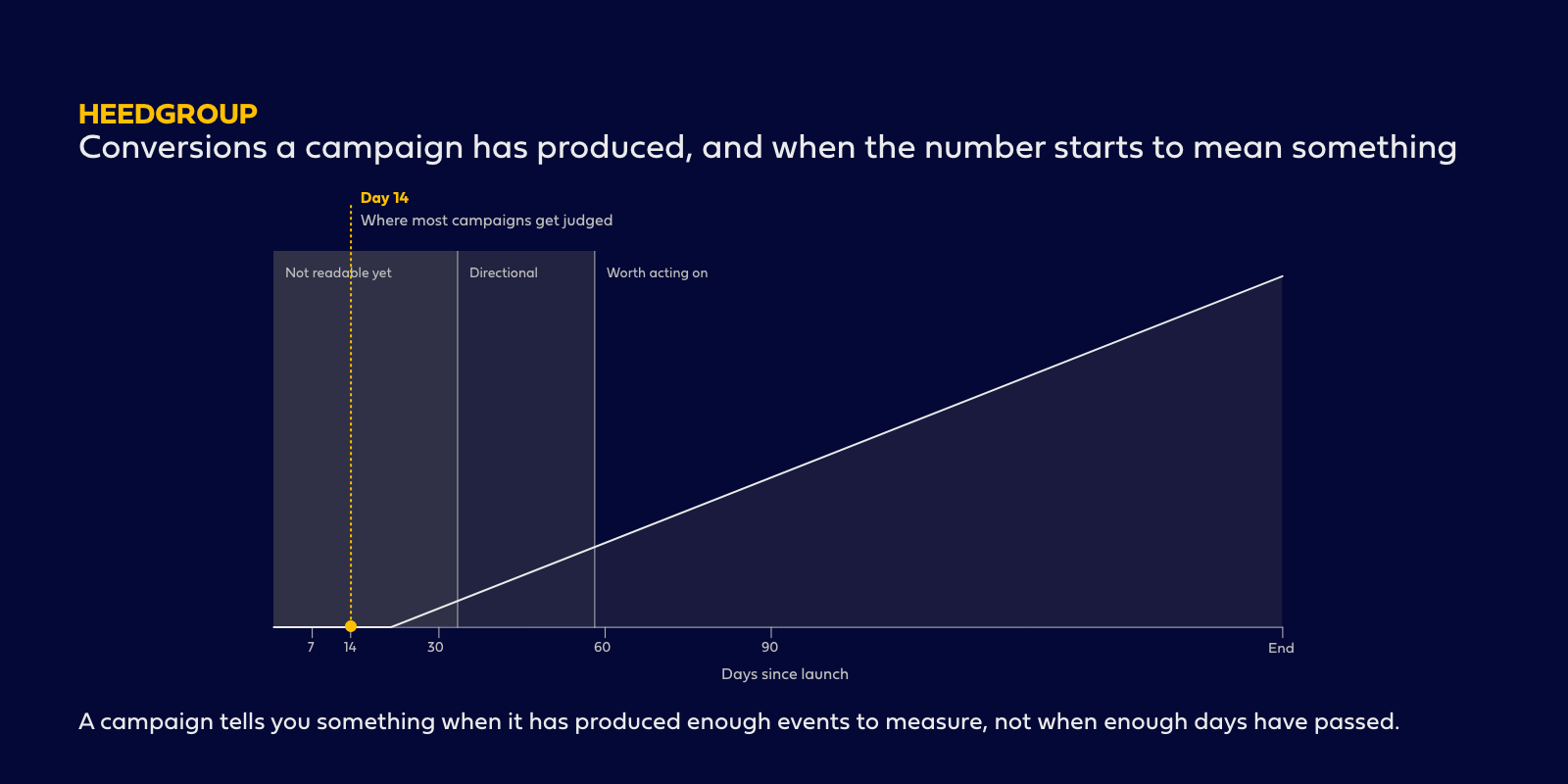
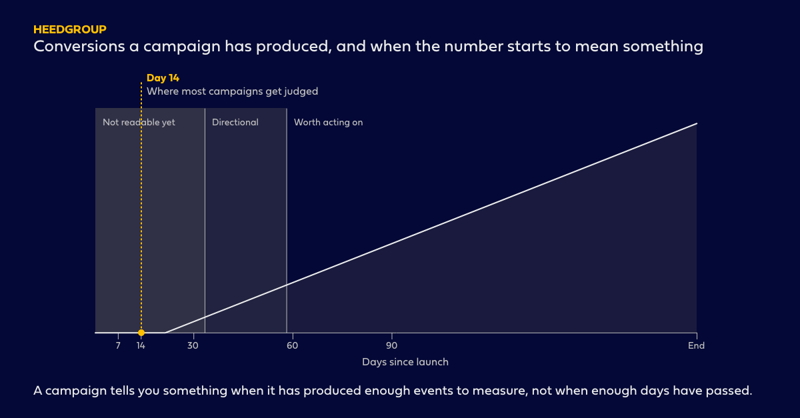
By day fourteen, about $1,000 has been spent and the campaign is just warming up. At $2,000 a demo, the expected number is zero.
Zero is not a sign that the campaign is failing. It is the most likely outcome of a campaign working exactly as planned but understanding whether the campaign is pacing correctly is the key to whether you need to act or wait.
Now run the same two weeks at a different firm. A product brand needs 400 units sold a month, which paced out is roughly 13 a day. By day fourteen in your campaign, you should be near 200 units sold. If you have sold 170, the campaign is inside a normal range. If you are only at 30 units sold, something is wrong and there is enough evidence to act on it.
Same fourteen days. In one case the number is decisive. In the other it is meaningless.
The difference is not the calendar. It is how many chances the spend has bought so far. A campaign tells you something when it has produced enough events to measure, not when enough days have passed.
Pacing is a budget question before it becomes a reporting one
Which means the two week check-in is not really where this gets decided. It is decided at the point the budget is set, and that is usually the least examined number in the whole plan.
In our experience the budget rarely comes from the goal. It comes from what was available, or what was left after the rest of the plan, or what sounded reasonable in a board deck. Then a goal gets attached to it, and from that moment everyone proceeds as though the two numbers were designed together.
Sometimes they were. Often they were not, and nobody has checked.
Agree internally on what the goal actually means before you spend
A brand sells a product at $25.00. The ad budget is $2,000 per month. The goal, as stated in the meeting, is a two-to-one return.
That sounds unambiguous. It is not.
If two-to-one (2:1) means return on ad spend:
- You spend $2,000, so you need $4,000 back in revenue. ($2,000 × 2)
- At $25 a unit, that is 160 units to sell a month. ($4,000 ÷ $25)
- Spread across 160 sales, your $2,000 budget can spend $12.50 to acquire each sale. ($2,000 ÷ 160)
If two-to-one (2:1) means return on what you actually keep after expenses:
- At a 40% margin, a $25 product earns you $10. ($25 × 0.40)
- You still need $4,000 back, but now it has to be $4,000 in profit, not revenue.
- At $10 a unit, that is 400 units a month. ($4,000 ÷ $10)
- Spread across 400 sales, your $2,000 budget can spend $5.00 to acquire each sale. ($2,000 ÷ 400)
Same goal, same budget, same product. Two-and-a-half times the volume and less than half the room to acquire a customer.
Those are not two versions of one campaign. Different channels make sense at $12.50 than at $5.00. Different creative, different audiences. A campaign built for the first number will look like it is underperforming against the second, when in fact it was aimed somewhere else from the day it launched.
None of that is a media or creative problem, and no amount of watching at day fourteen will surface it. It is arithmetic, and you can do it on paper before you spend a dollar. That is also where expectations get set, so the two week check-in is a comparison rather than a surprise.
Run your own numbers
Rather than describe the check, here it is. Put your figures in and it will show you both readings of your goal, what one conversion actually costs you against what you can afford to pay, and what the campaign should have produced by day 7, day 14, day 30 and on through to the end of the run, once your sales cycle is accounted for (in days).
If the budget cannot buy the conversions the goal requires, that is worth knowing in the kickoff. There are only a few levers, and all of them take time. Change the goal, change the budget, change the price or the margin, or extend the timeline. Most of those are decisions the go to market team makes together, and they go better in week one than in month three.
What to watch while the goal is still unreadable
None of this means the early weeks are dead time. It means you are watching different things.
Warming looks like movement in the early signals while the late ones stay flat. Delivery is clean, one creative is separating from the others, people are getting further along than they were last week, and the goal number has not moved. That is what a healthy campaign looks like at day fourteen. It is also what most people panic about.
Hitting is conversion volume tracking against what the pacing said it should be. Not the goal. The pace toward it.
Dying rarely shows up first in the final number. It shows up as a stall at a specific step. Traffic arrives and leaves. The form is opened and abandoned. Frequency climbs while response falls, which means you are reaching the same people repeatedly and they have decided. All of those are visible well before the goal number is ready to say anything.
Two things to do before your next campaign launches
Do the arithmetic in the kickoff. Goal, budget, allowable cost per sale, traffic required, and what that traffic costs. Write down the one number everyone is working to, so the media, the creative and the landing page are all built against the same target.
Then write down the pacing. How many sales the campaign should have produced by day 7, day 14 and day 30, given how much will have been spent by then and how long your sales cycle runs. That single page turns the two week check-in from an anxious conversation into a short one.
Zero at day fourteen is not failure. Not knowing whether it should have been zero is the actual problem, and it is one you can solve before launch.
If you are planning something and want a second set of eyes on the pacing before it launches, we are happy to take a look, just connect with us.